When an Exterior Steel Stair Is Past Repainting
How to tell whether a corroding exterior steel stair in Vancouver needs paint, repair, or replacement, and where corrosion hides before it shows.
Peeling paint is not the problem. It is the notice that something under the paint has been happening for a while.
Peeling paint on an exterior stair is not the problem. It is the notice that something underneath has been going on for a while, and the useful question is how far it has gone.
Coating failure and section loss are different findings
The distinction that governs every decision here is whether the steel has lost material.
A stair with a failed coating and sound steel underneath is a maintenance item. Preparation and recoating restore it, and the cost is proportionate. A stair that has lost section at a connection or through a stringer web is a structural item, and no coating restores steel that is no longer there.
From the ground, the two look similar. Both present as rust staining, flaking, and discolouration. That is why a visual impression is a starting point rather than a conclusion, and why heavy corrosion at connections warrants assessment by a qualified professional rather than a quote from a painter.
Corrosion starts where water stays and coatings are thin
Two conditions have to coincide, and on an exterior stair they coincide in predictable places.
Water needs somewhere to sit. Horizontal surfaces that do not drain are the obvious candidates: the back corners of pan treads, the flat top of a base plate, the inside of a channel section turned the wrong way, and any pocket formed where two members meet. In a wet coastal climate those surfaces stay damp for long periods rather than drying between rain events.
Coatings need to be thin or interrupted. Paint pulls away from sharp edges as it cures, so cut edges and corners carry less film than flat faces. Welds are worse again, because weld spatter, slag residue, and an irregular profile all make a poor substrate. Bolt holes, fastener heads, and anywhere the coating was chipped in handling complete the list.
Overlay the two and the map of where a stair rusts first is not mysterious. It is the underside of tread-to-stringer welds, the base of every post, and the pan corners.
The failure is usually older than it looks
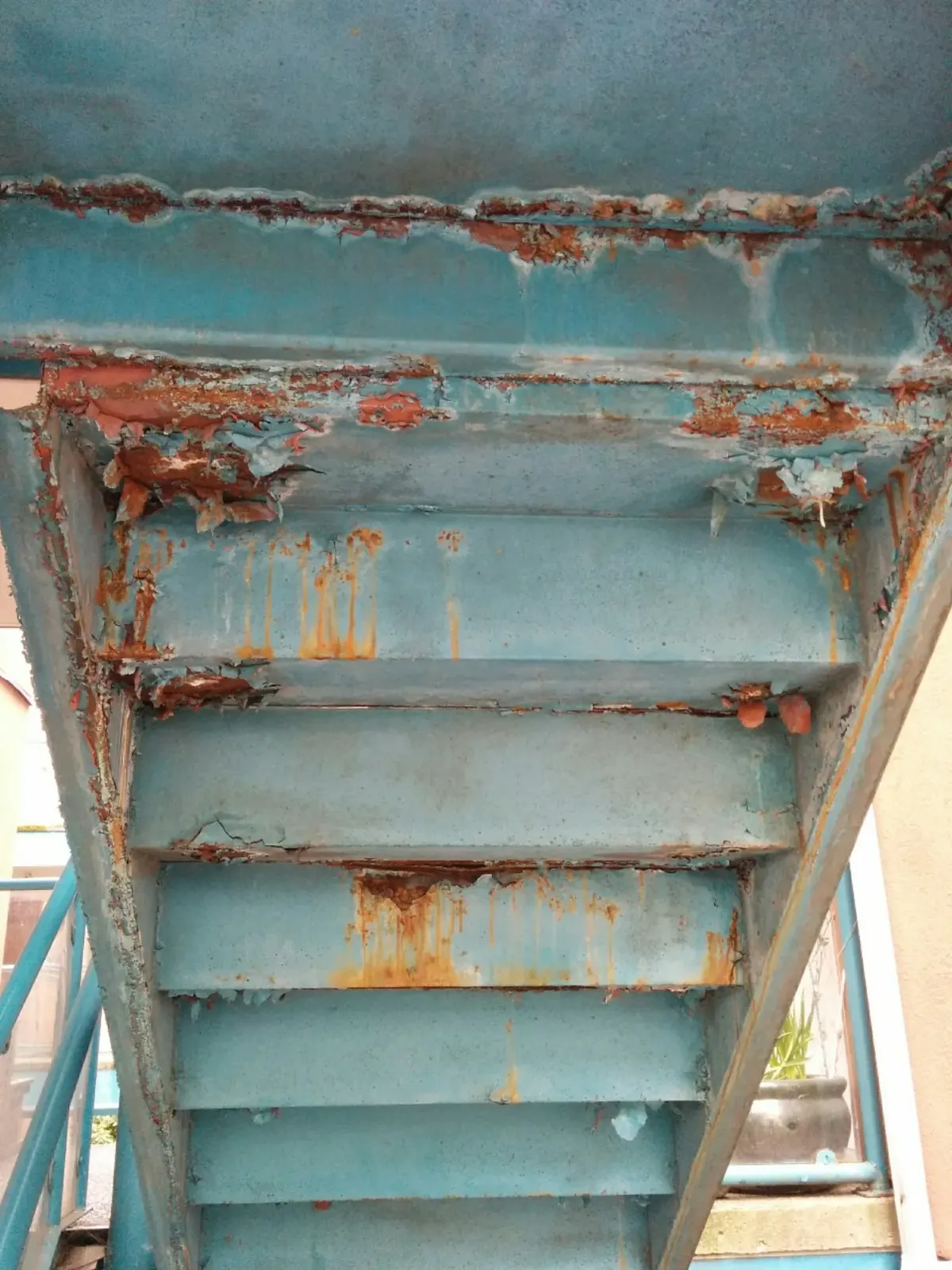
This is the part that surprises owners, and it is why the hero photograph above is instructive.
Corrosion under a coating progresses invisibly. The rust product occupies more volume than the steel it came from, so it lifts the coating from beneath, and the paint stays intact over the top of it for a while. By the time the film blisters, cracks, and flakes, the corrosion has already been running underneath.
Rust staining running down a tread face tells the same story. The stain is deposited by water carrying corrosion product out from somewhere else, which means the active site is usually above or behind the stain rather than at it. Following the stain to its source is more informative than assessing the stained surface.
The practical consequence is that a stair which “just started rusting” generally did not. It just started showing.
Preparation decides whether recoating lasts
Where the steel is sound, recoating is the right answer, and the outcome depends almost entirely on what happens before the coating goes on.
Coating over loose scale, existing failed film, or contaminated steel produces a repaint that fails on roughly the same schedule as the last one. Proper preparation means removing the failed coating and the corrosion product back to sound material, which on an existing stair usually means abrasive blasting or an equivalent mechanical method, and then coating within the window before flash rusting starts.
That is a different job from painting, and it is priced differently. A quote that seems inexpensive for repainting an exterior stair is often a quote for painting over the problem. The relevant comparison is not paint cost but how many years the system is expected to deliver, which is a question about preparation and the coating specification together. The trade-offs between coating systems are covered in exterior steel stairs and coastal finish.
Galvanizing changes the failure mode
Hot-dip galvanizing is common on exterior steel in Metro Vancouver for reasons that are visible in how corroded stairs behave.
A zinc coating applied by immersion bonds metallurgically to the steel and protects sacrificially, meaning the zinc corrodes preferentially and continues protecting the steel at small scratches rather than allowing undercutting to start there. The American Galvanizers Association’s guidance on hot-dip galvanizing in coastal climates covers how the coating behaves in marine-influenced environments.
That does not make galvanized steel permanent, and it does not remove the drainage question. A galvanized pan tread holding water still consumes its coating faster where the water sits. What it does change is that failure tends to be gradual and general rather than sudden and local, which makes it easier to plan for. The detailed comparison is in hot-dip galvanizing for exterior stairs on the North Shore.
Partial replacement is sometimes the right middle answer
Replace or repaint is a false pair. There is a third option, and on the right stair it is the economical one.
Where corrosion is genuinely localised, replacing the affected portion while retaining sound structure is practical. Treads can be replaced on sound stringers. A corroded bottom section where a stair meets grade, which is a common failure location because that is where water and debris collect, can be cut back and a new section fitted. Guards and handrails can be replaced independently of the flight.
The judgment is whether the retained portion is genuinely sound, and that is easier to establish once the failed coating is removed and the steel is visible. In our shop, partial replacement works well when the corrosion has an obvious boundary and poorly when it is general, because a patched stair with widespread underlying corrosion simply fails again next to the patch.
The base and the top connection deserve separate attention
Two locations carry more consequence than the rest of the stair.
Where the stair meets grade, water, soil contact, de-icing salt, and organic debris all concentrate. A post bearing on a pad that has settled, or set into concrete without provision for drainage, sits in exactly the conditions that drive corrosion. It is also structurally important, since that is where the stair transfers load. The related issues around footings are covered in exterior stair frost heave and footings.
Where the stair meets the building, the connection is often concealed behind cladding or under a landing, which means it is neither inspected nor maintained. Corrosion there can be advanced before anything is visible, and it can also damage what the stair is fixed to. Any assessment worth having includes getting eyes on that connection.
Deferring has an asymmetric cost
A corroding stair does not stay the same while a decision is postponed, and the options narrow as it progresses.
Early, the choice is between recoating and doing nothing. Later, recoating is off the table and the choice is between partial and full replacement. Later still, the stair may need temporary shoring or closure, which brings access and safety costs that dwarf the original repair.
For a strata, this maps onto the depreciation report and the funding decisions that follow from it, where a shared exterior stair is normally common property. Moving an item from planned maintenance to emergency capital work is the expensive path. The process considerations are similar to those in strata stair replacement.
A short inspection routine catches it early
None of this requires a specialist to spot, and a twice-yearly walk around an exterior stair finds most problems while they are still cheap.
Start underneath rather than on top. The undersides of treads, the inner faces of stringers, and the connection points are where corrosion begins and where nobody looks. A torch and five minutes cover it.
Check the base of every post. Look for staining running down onto the surface below, for coating lifting at the bottom 100 mm, and for any gap where the post meets its bearing surface that could be holding water. On stairs landing on grade, clear away soil, leaf litter, and moss that has built up against the steel, because organic debris holds moisture indefinitely.
Press on anything that looks blistered. Sound steel under a lifted coating feels solid; steel that has lost section can feel soft or flex. That is not a substitute for proper assessment, but it separates cosmetic from concerning.
Look at where the stair meets the building, if it is visible. Where it is concealed behind cladding, note that it cannot be inspected, which is itself worth knowing.
Photograph what you find, each time, from the same positions. A single photograph tells you the current state. A sequence over two or three years tells you the rate, and the rate is what actually decides whether to recoat now or plan a replacement. That record is also what makes a fabricator’s remote assessment useful rather than speculative.
What lets a fabricator give a useful answer
Most of this can be triaged from photographs before anybody visits.
Send overall photographs of the stair from both sides, close photographs of the base of each post, close photographs of the tread-to-stringer connections from underneath, a photograph of where the stair meets the building at the top, the overall dimensions and the height from grade, and notes on access for equipment and materials. Add the current finish if it is known, and whether the stair is a required exit.
That package is normally enough to say whether the conversation is about coating, partial replacement, or a new stair, and to flag whether a structural assessment should come first.
Sources
- Hot-Dip Galvanizing in Coastal Climates, American Galvanizers Association
- Hot-Dip Galvanizing in Coastal Environments, hotdipgalvanizing.com
- Differences Between ASTM A123 and CSA G164-18, American Galvanizers Association
The stairs that get replaced on somebody’s terms are the ones photographed and assessed while recoating was still an option. The ones replaced on the stair’s terms cost considerably more, and the timing is never convenient.
Related questions
Is surface rust on an exterior steel stair a serious problem?
Not on its own. Light surface rust on otherwise sound steel is a coating failure, and recoating after proper preparation usually resolves it. The concern is corrosion that has been progressing under an intact-looking coating, particularly at welds, connections, and anywhere water sits.
How do I know if the corrosion is structural?
You generally cannot tell from the surface, which is the honest answer. Section loss hides under scale and paint. Where a stair shows heavy scaling, pitting, or rust staining at the connections, a qualified professional should assess it rather than a coating contractor.
Where does corrosion usually start on an exterior stair?
Where water sits and where coatings are thinnest. That means the back corners of pan treads, the underside of tread-to-stringer welds, the base of posts, bolt holes, and any horizontal surface that does not drain. Edges and welds carry less coating than flat faces, so they go first.
Can a rusted stair just be sandblasted and repainted?
If the steel section is still sound, yes, and that is often the right answer. Preparation is what determines whether it lasts, because a coating over inadequately prepared steel fails again quickly. If the section has thinned, no coating restores it.
Why did my stair rust when it was painted?
Paint is a barrier, and barriers fail at their weakest point. A scratch, a chip at a bolt, a weld that was never properly prepared, or a horizontal surface holding water all give moisture a path to the steel. Once corrosion starts under the film, it spreads beneath the paint.
Is galvanizing better than paint for a Vancouver exterior stair?
Hot-dip galvanizing gives a metallurgically bonded zinc coating that protects sacrificially rather than only as a barrier, which is why it is common on exterior steel here. The American Galvanizers Association publishes guidance on how it performs in coastal environments. Cost, appearance, and the ability to recoat all factor into the choice.
How long should an exterior steel stair last in Metro Vancouver?
It depends far more on the finish, the detailing, and the exposure than on the steel. A well-drained galvanized stair away from salt spray behaves very differently from a painted stair with pan treads holding water near the water. Confirm expectations against the actual finish and location rather than a general figure.
What does it cost to replace an exterior stair versus repaint it?
Repainting is generally the cheaper single intervention and replacement is the more durable one. Which is better value depends on how much section is left and how many more repaint cycles the stair can absorb. Confirm both against current quotes.
Can part of a stair be replaced instead of the whole thing?
Sometimes. Replacing treads while retaining sound stringers is done, and so is replacing a corroded bottom section where the stair meets grade. In our shop, partial replacement works best when the corrosion is clearly localised to one area and the rest of the assembly is genuinely sound.
Does a corroded stair affect a strata's obligations?
A shared exterior stair is common property in most strata buildings, and its condition is typically tracked through the depreciation report and the maintenance planning that follows from it. Deferred repair on a corroding stair tends to move it from a maintenance item to a capital one.
Should I replace a stair that only fails on appearance?
Not necessarily. Staining and coating failure are appearance problems until they are not, and a stair that looks poor can be structurally fine. The decision changes once the corrosion reaches the connections, because that is where consequences are structural rather than cosmetic.
What should I send a fabricator to price a replacement?
Send photographs of the full stair, close photographs of the base of the posts and the tread-to-stringer connections, the overall dimensions, the height from grade to the landing, photographs of what the stair connects to at the top, and site access details. That is usually enough to say whether repair or replacement is the sensible conversation.