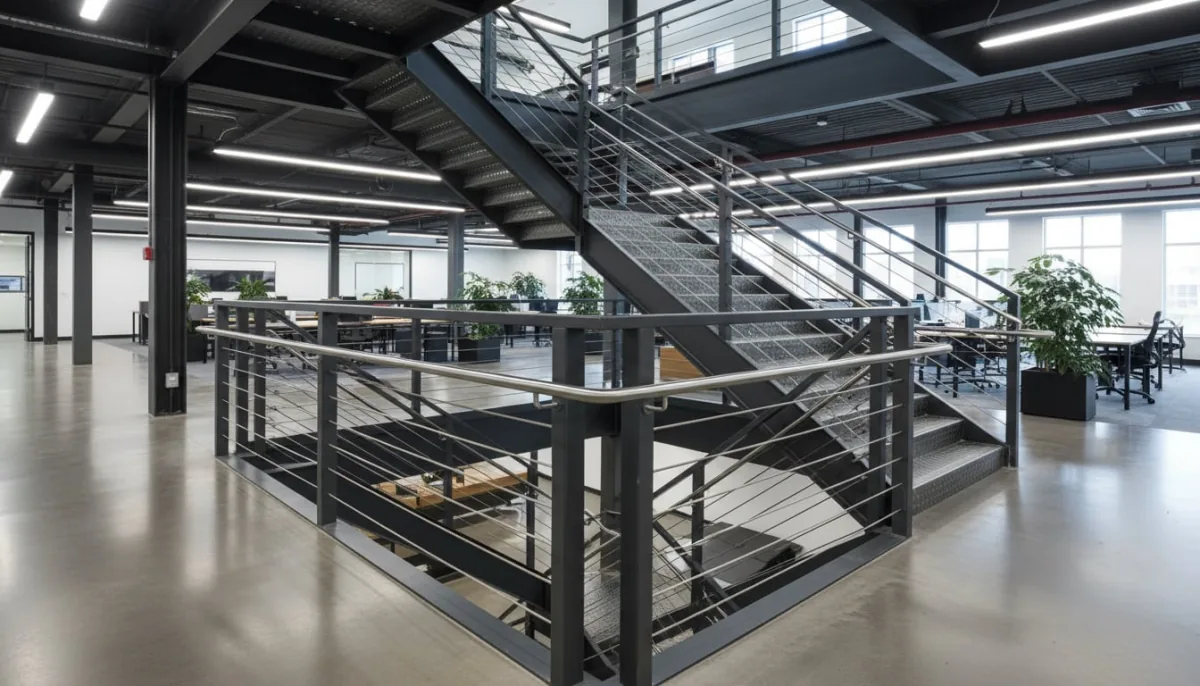
Cable railing is the infill people ask for when they want a view without paying for glass, and it delivers that. It is also the only common infill whose compliance changes over time. A picket stays where it was welded. A cable stretches. That single property drives every design decision in a cable system: how far apart the posts go, how many intermediate supports the run needs, what hardware holds the tension, and what maintenance the owner is signing up for. Get the geometry right and a cable guard is excellent. Get it wrong and it opens past the sphere rule within a few years of handover.
The sphere rule applies to cable, under tension
The guard rule is the same for cable as for anything else: no opening may allow a 100 mm sphere to pass through. The complication is that a cable is flexible. Push a sphere against two adjacent horizontal cables and they spread apart, so the opening under load is larger than the opening at rest. Cable spacing therefore has to be set tighter than the bare 100 mm dimension would suggest, and the tension has to be high enough that the cables resist spreading when pushed.
- Spacing is measured under load, not at rest, because cable deflects when pushed.
- Tension is what resists spreading, so an undertensioned run can fail a sphere check that a tensioned one passes.
- Stainless cable stretches over its life, so tension drops without intervention.
- Longer spans deflect more for the same tension, which is why post spacing governs the design.
Post spacing is the single most important decision
Every problem in a cable railing traces back to how far apart the posts are. Longer spans mean more cable deflection under a given push, which means the cables have to be tensioned harder to stay compliant, which means a larger inward force pulling the end posts toward each other. That force is real and cumulative: a run with many cables applies a substantial combined tension load to the terminal posts. Underbuilt end posts bow inward over time, which slackens every cable in the run at once. The end posts and their anchors do the structural work in a cable system, and they should be sized and anchored for the full accumulated tension.
Intermediate supports keep long runs honest
Where a run has to be longer than the post spacing allows, intermediate supports carry the cables without terminating them. These are drilled posts or standoff spacers that the cable passes through, breaking the unsupported length into shorter segments so deflection stays within limits. They add cost and they interrupt the clean look slightly, and they are usually the difference between a long cable run that stays compliant and one that does not. Designers who want an uninterrupted forty-foot sightline with no intermediate posts are usually asking for something that will not hold its spacing.
Vertical cable is an alternative worth considering
Running the cables vertically instead of horizontally removes the climbability concern entirely, since there is no foothold, and it changes the tensioning geometry because the cables run between a top and bottom rail rather than between end posts. The trade is that the top and bottom rails now carry the tension and must be stiff enough not to bow. Vertical cable is less common in Metro Vancouver than horizontal but is a reasonable answer where children are present and the client still wants the cable look. Climbability considerations are covered in our guard climbability guide.
Stainless grade: 316 for anything near salt water
Cable and its fittings are stainless steel, and the grade decision matters more here than on most railing hardware because the fittings contain crevices where water sits. For interior work and inland exterior sites, 304 is generally adequate. For waterfront, near-shore, and salt-exposed Metro Vancouver locations, 316 is the specification, and the price difference is small relative to the cost of replacing a corroded run. The 304 versus 316 guide covers where the line falls. Note that stainless is not maintenance-free outdoors: it needs periodic washing to remove salt deposits, or it develops surface staining even at 316.
Hardware families and what they cost you later
Cable systems terminate in one of a few ways, and the choice affects both installation and every future retensioning.
| Termination | Adjustability | Look | Retensioning |
|---|---|---|---|
| Swage stud with turnbuckle | High | Visible hardware at post | Straightforward, turn the fitting |
| Field-swageless fitting | Medium | Compact at post face | Possible, some designs limited |
| Factory-swaged to length | None | Cleanest | Requires the opposite end to adjust |
| Concealed in-post tensioner | Medium | Hardware hidden | Access panel or post cap must be removable |
What maintenance actually looks like
A cable guard is not a fit-and-forget product. It needs the tension checked periodically, more often in the first year or two while the initial stretch works itself out, and less often after that. It needs washing on exterior installations to keep salt off the fittings. And it needs the sphere check repeated whenever the tension is adjusted, because that is the reason the tension matters. We tell clients to plan on checking a new exterior cable run within the first year and then on a regular interval after that. An owner who will not do this is better served by pickets.
Where cable is the right answer, and where it is not
Cable is a good fit on a deck or balcony where the view is the reason the space exists and the budget will not stretch to glass, on a long modern interior run where the sightline matters, and on commercial and industrial stairs where the look suits the building. It is a poor fit where nobody will maintain it, where the run is very long with no tolerance for intermediate posts, and on a family home with a high drop where the horizontal geometry is a climbing concern. Cost comparison against picket infill is in our picket vs cable cost guide.
The failure we get called about
The recurring call is a cable deck railing three to six years old where the cables can be pushed apart by hand well past where they should move. Almost always the cause is a combination: post spacing that was too generous, end posts that were not built for the accumulated tension and have bowed inward, and no retensioning since installation. The fix is rarely just retensioning, because the geometry that caused it is still there. Adding intermediate posts, or replacing end posts with a properly anchored detail, is what actually resolves it.
Related questions
Do cable railings meet BC Building Code?
Cable railings comply when the cable spacing keeps a 100 mm sphere from passing through under load, and when the guard as a whole resists the required horizontal load. The complication specific to cable is that it is flexible and stretches over time, so a run that passes at handover can open beyond the limit later. Compliance depends on correct post spacing, adequate tension, and periodic retensioning through the guard's life.
How far apart should cable railing posts be?
Post spacing depends on the cable diameter, the number of cables, the tension the system holds, and the deflection limit the design has to meet, so it is set by the system's engineering rather than by a single universal number. The relationship is fixed: longer spans deflect more under the same push, so they need higher tension, which loads the end posts harder. Where a long uninterrupted run is wanted, intermediate supports break up the unsupported length.
How often does a cable railing need retensioning?
More often at first, less often later. Stainless cable does most of its initial stretching in the first year or two after installation, so a new exterior run should be checked within the first year and then on a regular schedule after that. Any time the tension is adjusted, the sphere check should be repeated, since maintaining that clearance is the reason the tension matters in the first place.
Should I use 304 or 316 stainless for cable railing?
316 for waterfront, near-shore, and salt-exposed Metro Vancouver sites, and 304 for interior work and inland exteriors. Cable fittings contain crevices where moisture sits against the metal, which is the condition that starts corrosion, so the grade matters more here than on simpler hardware. Even 316 needs periodic washing outdoors to remove salt deposits, or it develops surface staining.
Why do the end posts matter so much in a cable railing?
The end posts carry the accumulated tension of every cable in the run, pulling them inward toward each other. That combined load is substantial on a multi-cable guard. If the end posts or their anchors are underbuilt, they bow inward over time, which slackens every cable at once and opens the spacing past the sphere limit. Most cable railings that fail years after installation fail at the end posts, not at the cables.
Is vertical cable better than horizontal?
Vertical cable removes the climbability concern, because vertical members give a child no foothold, which is the main objection to horizontal cable in a family home. The trade is that the top and bottom rails now carry the tension and have to be stiff enough not to bow. Vertical cable is less common in Metro Vancouver than horizontal but is a sound option where children are present and the cable look is still wanted.
Can cable railing be used on stairs?
Yes, and it is common on both residential and commercial stairs. The raked geometry adds one complication worth flagging: the triangular gap where the lowest cable meets the tread nosing is a spot where the sphere rule is frequently missed. The stair also needs a compliant graspable handrail separately, since cable infill and a top rail do not automatically satisfy the handrail requirement.
How does cable railing cost compare to glass?
Cable sits below glass and above basic picket infill in Vancouver Stairs quotes. It avoids the panel cost, the heavy hardware, and the structural allowance that a frameless glass guard demands from the substrate, while giving a comparable open sightline. The saving is partly offset over time by the retensioning maintenance that glass does not require.
Can I install a cable railing on an existing deck?
Often, but the anchoring is the question rather than the cable. The end posts have to resist the full accumulated tension of the run, which means a structural connection into framing designed for it rather than a fastener into a rim joist. Many existing Metro Vancouver decks need blocking or a reinforced post detail added before a cable guard can be installed correctly.
What causes a cable railing to sag?
Three causes, usually together: post spacing too generous for the cable and tension used, end posts not built for the accumulated inward tension so they bow over time, and no retensioning since installation. Retensioning alone rarely fixes it, because the geometry that caused the sag is unchanged. The durable repair is adding intermediate supports or rebuilding the end posts with a properly anchored detail.
Continue reading
- Previous: Glass Guard Systems
- Next: Exterior Railings & Corrosion
- Railings and guards hub overview
- BC Building Code for stairs and guards
Discuss cable railing systems: tension, post spacing, and staying compliant for a real Vancouver project
Send drawings, photos, or a rough scope and we will help define the practical next step.