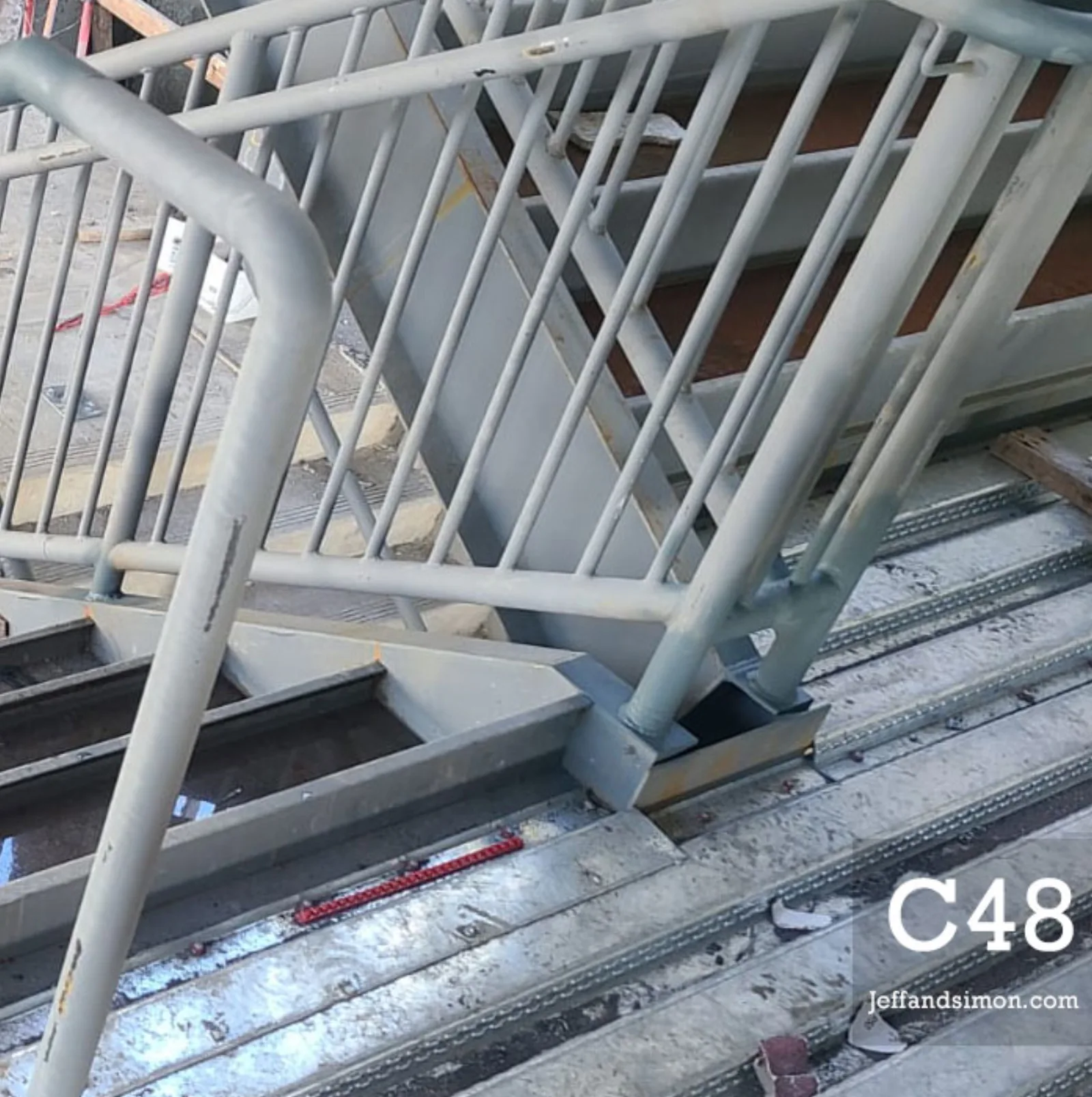
Infill is the part of a guard between the top rail and the bottom, and it is the decision that sets the character of the railing. The frame carries the load, the infill carries the look. Five families cover almost every project we quote in Metro Vancouver: vertical pickets, glass panels, horizontal cable, perforated or woven mesh, and solid panel. Each one interacts differently with the 100 mm sphere rule, each one has a different maintenance profile in a wet coastal climate, and the cost spread between the cheapest and the most expensive is wide enough to change a project budget on its own.
Vertical pickets: the predictable default
Vertical pickets, square bar or round rod welded between a top and bottom rail, are the most forgiving infill to fabricate and the easiest to get through inspection. Spacing is set so a 100 mm sphere cannot pass between adjacent pickets, which in practice means a clear opening under 100 mm regardless of picket dimension. Because pickets are vertical, they offer no foothold, which matters where children are present.
- Simplest sphere-rule compliance: spacing is a single repeated dimension, easy to verify.
- No climbability concern, vertical members give a child nothing to stand on.
- Most forgiving on a raked stair, pickets simply change length down the flight.
- Highest visual mass of the five, it reads as a barrier rather than as a transparent edge.
- Cheapest per linear metre in steel of the five families in most of our quotes.
Glass: transparency at a structural cost
Glass guards give the open sightline that drives most high-end Vancouver stair and balcony design. They come in two families: framed or channel-captured panels, and frameless panels held by base shoe or point-fixed standoffs. Glass is heavier than every other infill by a wide margin, and that weight lands on the substrate. A frameless glass guard on a balcony needs the slab edge or the framing to have been designed for it, which is a decision that has to be made before the concrete is poured, not after. Glass also has to be the correct laminated build-up for a guard application, covered in our laminated vs tempered glass guide. Deeper detail on systems and hardware is on the glass guard systems page.
Horizontal cable: minimal look, maximum tensioning discipline
Stainless cable infill gives a near-transparent edge with far less weight than glass and a lower material cost. The trade is discipline. Cable meets the sphere rule only while it stays under tension, and cable stretches, so the spacing that passed at handover can open up over a few years if the system was not specified and tensioned correctly. Span length drives everything: the longer the run between posts, the more intermediate support the cable needs to stop deflection when someone leans on it. On exterior work, 316 stainless is the specification for coastal exposure, and the difference from 304 is covered in our 304 vs 316 guide. Full detail is on the cable railing systems page.
Mesh and perforated panel: the commercial workhorse
Woven wire mesh and perforated plate infill show up on parkades, industrial stairs, school and civic projects, and increasingly on residential work where a designer wants texture rather than transparency. Mesh handles the sphere rule easily because the aperture is far below 100 mm. It resists climbing better than horizontal cable. It hides dirt well in an industrial setting and badly in a residential one, because the aperture collects grime that is difficult to wash out. Galvanizing before the frame is coated is the durable route for exterior mesh.
Solid panel: privacy and wind, at the cost of load
Solid steel plate, aluminium panel, or composite panel infill is used where privacy matters more than sightline: a balcony overlooking a neighbour, a rooftop terrace, a street-facing patio. It satisfies the sphere rule trivially, since there are no openings. The catch is wind. A solid panel guard is a sail, and on an exposed Vancouver rooftop or a waterfront balcony the wind load on a solid guard is materially higher than on a cable or picket guard of the same height. That load has to go into the posts and then into the structure, which usually means heavier posts and a stiffer anchor than the same railing with an open infill.
The five compared on the factors that decide projects
Relative cost below is the infill and its hardware only, ranked against each other rather than quoted in dollars, since the frame, the finish, the run length, and the site access move the installed number far more than the infill family does. For real figures see the railing cost guide.
| Infill | Relative cost | Sightline | Maintenance | Best use |
|---|---|---|---|---|
| Vertical picket | Lowest | Blocked | Low, recoat on schedule | Interior stairs, budget-led exteriors, child safety |
| Glass | Highest | Fully open | High, visible cleaning | View balconies, feature stairs, high-end interiors |
| Cable | Medium to high | Nearly open | Medium, retension periodically | Decks, modern interiors, long open runs |
| Mesh or perforated | Medium | Filtered | Medium, hard to clean | Parkades, industrial, civic, textured residential |
| Solid panel | Medium | Blocked | Low | Privacy balconies, wind screening, street frontage |
Climbability is a design question, not just a code one
Horizontal members in a guard give a child a foothold. Whether a given horizontal arrangement is restricted depends on the occupancy and the code edition that applies to your project, and the requirements around climbability have been treated differently across editions and between Part 9 and Part 3, so this is one to confirm with your AHJ rather than assume. As a practical matter, on a family home with a high drop we steer toward vertical pickets, glass, or mesh over widely spaced horizontal rails, regardless of what the minimum permits. Our climbability guide covers the design considerations.
How exposure narrows the list
Metro Vancouver's wet winters and salt-air waterfront sites eliminate options fast. Interior infill can be almost anything. Covered exterior tolerates most systems with a good coating. Fully exposed and coastal sites push toward hot-dip galvanized steel under a topcoat, 316 stainless, or aluminium, and away from anything with a crevice that traps water. Cable fittings and glass base shoes both create crevices, which is where exterior corrosion starts. The exterior railings and corrosion page covers the finish decision by exposure class.
What we recommend when the client has no strong preference
For an interior stair in a Vancouver custom home with a view worth protecting, frameless glass with a slim top-mounted handrail. For an interior stair where budget is the constraint, powder-coated vertical pickets with a wall-mounted handrail on the opposite side. For a deck or a covered balcony, 316 stainless cable with properly spaced intermediate posts. For a strata rebuild, picket or mesh in hot-dip galvanized steel under a topcoat, because the maintenance interval matters more than the sightline when a council is funding it across fifty units.
Related questions
Which railing infill is the cheapest?
Vertical steel pickets are the lowest-cost infill family in most Vancouver Stairs quotes. The material is inexpensive, the fabrication is repetitive, and compliance with the 100 mm sphere rule is a single repeated spacing dimension that is quick to verify. Glass is consistently the most expensive because of the panel cost, the hardware, and the structural allowance the substrate has to make for its weight.
Does cable railing meet the 100 mm sphere rule?
Cable railing meets the 100 mm sphere rule only while the cables stay under proper tension. Stainless cable stretches over time, so spacing that passed at handover can open beyond the limit within a few years if the system was under-specified or not retensioned. Longer spans between posts deflect more when leaned on. Correct post spacing, intermediate supports, and a retensioning schedule are what keep a cable guard compliant.
Is glass railing worth the extra cost?
Glass is worth it where the sightline is the point, a view balcony, a feature stair in an open-plan home, or a space where a solid guard would visually cut the room in half. It is not worth it where the guard faces a wall or a fence. Glass also carries a weight penalty that the supporting structure has to accommodate, which is a decision made before a slab is poured rather than after.
Which infill needs the least maintenance in Vancouver?
Vertical pickets in hot-dip galvanized steel under a topcoat need the least attention on a Metro Vancouver exterior. There are no moving parts, no tension to check, and no transparency to preserve, so the only maintenance is recoating on schedule. Glass needs frequent cleaning to keep the benefit it was bought for. Cable needs periodic retensioning to stay compliant.
Can I mix infill types on the same project?
Yes, and it is common. A frequent Vancouver pattern is frameless glass on the feature stair inside the home and powder-coated picket or cable on the exterior deck, where salt air and weather make glass maintenance tiresome. Mixing works best when the frame, the post profile, and the finish colour stay consistent across both, so the two systems read as one family rather than two unrelated railings.
Are horizontal railings allowed in BC?
Horizontal members in a guard raise a climbability concern, because they give a child a foothold. How that is treated depends on the occupancy and the code edition applying to your project, and it has been handled differently across editions and between Part 9 and Part 3. Confirm the requirement with your AHJ rather than assuming. On family homes with a high drop we recommend vertical pickets, glass, or mesh regardless of the minimum.
What infill works best for a strata railing replacement?
Picket or mesh infill in hot-dip galvanized steel with a topcoat is the usual recommendation for strata work. A council is funding the replacement across many units and cares about the maintenance interval more than the sightline, so a system with no tensioning schedule and no transparency to preserve costs less over the building's life. Our strata railing decision guide covers the council approval process.
Does mesh infill satisfy the sphere rule?
Yes, easily. Woven wire mesh and perforated plate have apertures far smaller than 100 mm, so the sphere rule is satisfied by the material itself rather than by a spacing dimension a fabricator has to hold. That makes mesh straightforward to get through inspection. The trade is cleaning: the aperture that guarantees compliance also traps grime that is difficult to wash out.
Why does a solid panel guard need heavier posts?
A solid panel guard catches wind that an open infill lets through. On an exposed Vancouver rooftop or a waterfront balcony, the wind load on a solid guard is materially higher than on a picket or cable guard of the same height, and that load travels into the posts and then into the building structure. The result is usually heavier posts and a stiffer anchor detail than the same railing with an open infill.
Which infill is best for a home with young children?
Vertical pickets, frameless glass, or mesh. All three deny a child a foothold, which widely spaced horizontal rails do not. Glass has the additional benefit that a parent can see through it to a child on the stair. Whichever is chosen, the gap where the bottom rail meets the tread nosing on a raked stair is the spot most often missed on a sphere-rule check, so it is worth verifying specifically.
Continue reading
- Previous: Guard vs Handrail Explained
- Next: Glass Guard Systems
- Railings and guards hub overview
- BC Building Code for stairs and guards
Discuss railing infill compared: picket, glass, cable, mesh, and panel for a real Vancouver project
Send drawings, photos, or a rough scope and we will help define the practical next step.