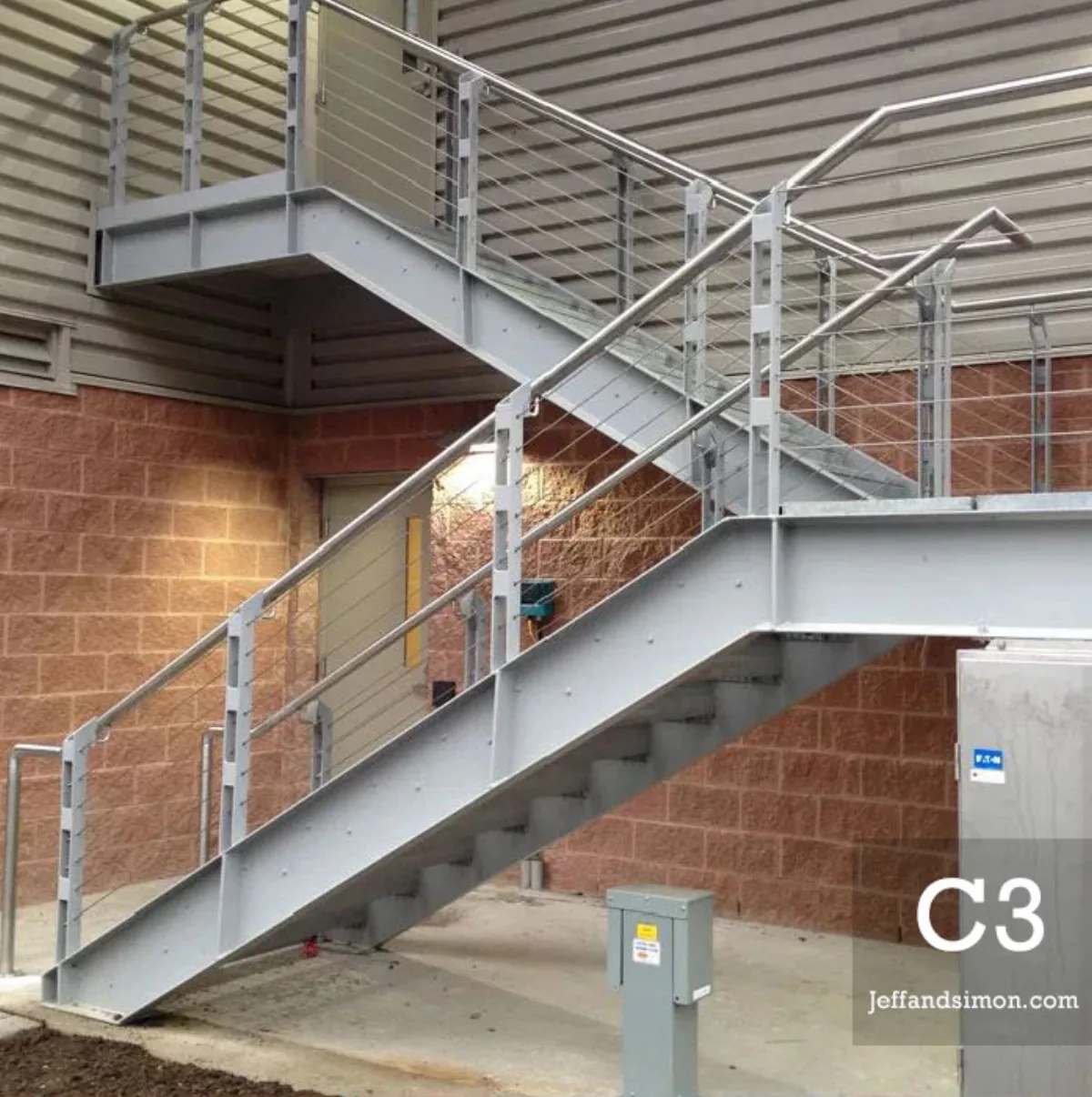
Exterior railings in Metro Vancouver do not fail evenly. They fail at the base of the posts, at the fasteners, and inside any crevice where water can sit and not drain. Everything above those points usually looks fine while the connection underneath is quietly losing section. That pattern is why finish selection is a structural decision rather than a cosmetic one, and why the right answer changes between a covered inland balcony and an exposed railing fifty metres from salt water.
Four exposure classes, four different answers
We sort exterior railing projects into four exposure classes, because the finish that is correct for one is wasteful or inadequate for another. The classification is about how much water reaches the steel and how long it stays there, plus whether that water carries salt.
- Covered exterior: a balcony under a roof or deep overhang, wetted rarely, drying quickly.
- Fully exposed inland: an open deck or rooftop with no salt influence, wetted through the winter.
- Near-shore: within reach of wind-carried salt spray, even without direct contact with the water.
- Waterfront and marine: direct salt spray, standing salt deposits, the harshest class in the region.
Finish options ranked by what they survive
Each finish family buys a different amount of protection, at a different cost. The right choice is the cheapest one that comfortably covers the exposure class, with headroom rather than exactly at the limit.
| Finish | Suits | Weak point | Relative cost |
|---|---|---|---|
| Powder coat over prepared steel | Interior, covered exterior | Any coating breach exposes bare steel | Lowest |
| Hot-dip galvanize plus topcoat | Fully exposed inland, near-shore | Field cuts and welds break the coating | Medium |
| 304 stainless | Covered and inland exterior | Pits in salt exposure | High |
| 316 stainless | Near-shore, waterfront | Still stains without washing | Highest |
| Aluminium with anodize or coating | Exposed, salt-adjacent | Softer, connection detailing differs | Medium to high |
Hot-dip galvanizing is the workhorse, with one condition
For most exposed exterior steel railings in Metro Vancouver, hot-dip galvanizing under a topcoat is the durable and cost-effective answer. The zinc protects the steel sacrificially, so a scratch that reaches through the topcoat does not immediately start rust the way it would on a powder-coated railing. The condition attached is sequencing: the steel has to be fully fabricated, with every hole drilled and every weld complete, before it goes in the kettle. A field cut or a site weld after galvanizing breaks the coating at exactly the point that most needs it, and a brush-applied repair is a patch rather than a restoration. Our galvanizing guide covers the process and its scheduling implications.
The base of the post is where it starts
The single most common exterior railing failure we are called to look at is corrosion at the post base. The reason is simple: it is the lowest point, so water runs down the post and collects there, and if the base plate sits flat on a deck or slab, water wicks underneath and never dries. The details that prevent it are unglamorous and cheap at fabrication time. Drain the post so water cannot fill it. Detail the base so water leaves rather than pools. Use a setting detail that keeps the plate off the wet surface where the design allows. None of these can be added later without removing the railing.
Fasteners are the second failure point
Mixing metals at a connection creates galvanic corrosion, where the less noble metal corrodes preferentially. A carbon steel fastener into a stainless post, or the wrong fastener into galvanized steel, will fail years before either component does. The fastener specification has to match the components it joins and the exposure it sits in, and on near-shore and waterfront work that generally means stainless of the appropriate grade with isolation where dissimilar metals meet. This detail is invisible on a quote and decisive over the railing's life.
Crevices are where coastal railings die
Any place two surfaces meet with a narrow gap between them holds water against the metal and starves it of oxygen, which is the condition that starts crevice corrosion, and it happens on stainless as readily as on coated steel. Railings are full of these: a glass base shoe channel, the inside of a cable fitting, the gap between a base plate and its substrate, a lapped joint that was not sealed or was sealed on the wrong side. Designing crevices out, or ensuring they drain, does more for an exterior railing's life than upgrading the finish one step.
Stainless is not maintenance-free outdoors
Clients frequently assume stainless means no upkeep. On a Metro Vancouver waterfront site, 316 stainless still develops surface staining, sometimes called tea staining, if salt deposits are left on it. The metal underneath is generally sound, but the appearance degrades and the client is unhappy with a premium product. Periodic washing with fresh water removes the salt and prevents it. The 304 versus 316 guide covers where the grade upgrade is justified, and our coastal exposure finish guide covers marine sites specifically.
Repairing versus replacing a corroded railing
The question we get asked is whether an existing exterior railing can be saved. The answer depends on where the corrosion is. Surface rust on an otherwise sound guard is a preparation and recoating job. Corrosion at the post bases, at the connections, or inside the posts is a structural question, because those are the elements carrying the guard load, and section loss there is not cosmetic. There is also a code dimension: a renovation that touches the guard generally triggers a rebuild to current height and sphere-rule requirements, so an old railing that was compliant when built may not be replaceable like for like. Our corrosion replacement guide covers the assessment.
What we specify by exposure, in practice
For a covered inland balcony, powder coat over well-prepared steel with drained posts. For a fully exposed deck or rooftop away from the water, hot-dip galvanized steel with a topcoat, fabricated complete before galvanizing. For a near-shore site, galvanized and topcoated steel or 316 stainless, with stainless fasteners and attention to every crevice. For a waterfront railing in direct spray, 316 stainless or aluminium, detailed to drain everywhere, with a fresh-water washing expectation set with the client before they choose it.
Related questions
What finish is best for an exterior railing in Vancouver?
It depends on the exposure. A covered balcony takes powder coat over prepared steel. A fully exposed inland deck or rooftop should be hot-dip galvanized with a topcoat. A near-shore site needs galvanized and topcoated steel or 316 stainless. A waterfront railing in direct salt spray needs 316 stainless or aluminium. The rule is to choose the cheapest finish that comfortably covers the exposure with headroom, rather than one that only just meets it.
Why do exterior railings rust at the bottom of the posts first?
The post base is the lowest point, so water runs down the post and collects there. Where a base plate sits flat against a deck or slab, water wicks underneath and never dries, keeping the steel wet continuously. The preventions are cheap at fabrication and impossible to add later: drain the post so it cannot fill with water, detail the base so water leaves rather than pools, and keep the plate off the wet surface where the design allows.
Is hot-dip galvanizing worth the extra cost?
On any fully exposed Metro Vancouver exterior, yes. Zinc protects the steel sacrificially, so a scratch through the topcoat does not immediately start rust the way it does on a powder-coated railing. The condition is sequencing: the steel must be fully fabricated, with all holes drilled and welds complete, before galvanizing. A field cut or site weld afterward breaks the coating exactly where protection matters most.
Does stainless steel railing need maintenance outdoors?
Yes. On a Metro Vancouver waterfront site, even 316 stainless develops surface staining, sometimes called tea staining, when salt deposits are left on it. The metal underneath is usually sound but the appearance degrades, which frustrates clients who paid a premium expecting no upkeep. Periodic washing with fresh water removes the salt and prevents the staining from developing.
What is galvanic corrosion in a railing?
Galvanic corrosion happens where two dissimilar metals meet in the presence of moisture, and the less noble metal corrodes preferentially. In railings it shows up at fasteners: a carbon steel fastener into a stainless post, or the wrong fastener into galvanized steel, will fail years before either component does. The fastener specification has to match the components it joins and the exposure it sits in, with isolation where dissimilar metals meet.
Why do crevices matter more than the finish?
A crevice is any narrow gap between two surfaces that holds water against the metal and starves it of oxygen, which is the condition that starts crevice corrosion. It affects stainless as readily as coated steel. Railings are full of them: glass base shoe channels, cable fitting interiors, the gap under a base plate, unsealed lapped joints. Designing crevices out or making them drain extends an exterior railing's life more than upgrading the finish one step.
Can a rusted exterior railing be repaired instead of replaced?
It depends where the corrosion is. Surface rust on an otherwise sound guard is a preparation and recoating job. Corrosion at post bases, at connections, or inside the posts is structural, because those elements carry the guard load and section loss there is not cosmetic. A renovation that touches the guard also generally triggers a rebuild to current height and sphere-rule requirements, so like-for-like replacement is not always available.
Should I use 304 or 316 stainless outdoors in Vancouver?
304 is generally adequate for covered and inland exterior railings. 316 is the specification for near-shore and waterfront sites where wind-carried salt spray reaches the metal. The difference matters most inside crevices, such as cable fittings and base shoe channels, where moisture sits against the steel. The cost difference between grades is small compared to replacing a corroded run early.
Is aluminium a good choice for exterior railings?
Aluminium performs well in salt-adjacent Metro Vancouver exposures and avoids the rusting behaviour of steel entirely. The trade-offs are structural rather than corrosive: aluminium is softer than steel, so connection detailing and section sizing differ, and it needs isolation where it meets dissimilar metals to avoid galvanic corrosion. It is a reasonable answer on exposed and near-shore work where the design suits it.
How long should an exterior railing last in Metro Vancouver?
Service life depends almost entirely on whether the finish matched the exposure and whether the details drain. A correctly galvanized and topcoated railing on an exposed inland deck, with drained posts and matched fasteners, will substantially outlast a powder-coated railing in the same position. The failures that arrive early are nearly always specification mismatches or trapped water at the base, rather than the coating simply wearing out.
Continue reading
- Previous: Cable Railing Systems
- Next: Railing Cost Guide
- Railings and guards hub overview
- BC Building Code for stairs and guards
Discuss exterior railings and corrosion: choosing a finish by exposure for a real Vancouver project
Send drawings, photos, or a rough scope and we will help define the practical next step.